
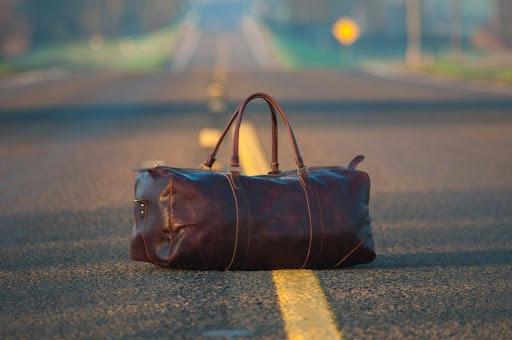
There’s a particular kind of regret that comes from buying the wrong travel bag. You notice it the first time a seam starts to pull at the airport, or when the “leather” trim peels after a single rainy weekend. A good leather duffle bag should do the opposite — it should look better in five years than it did the day you bought it.
The trouble is that the words used to sell these bags (“premium,” “genuine,” “handcrafted”) have been worn smooth from overuse. They tell you almost nothing. So this guide skips the marketing language and walks through what actually determines whether a leather duffle is worth your money: the leather itself, the construction, the proportions, and how it carries when it’s full.
Whether you’re shopping for a weekender, a gym bag, or a carry-on you’ll use for years, the criteria below will help you judge any bag on its merits.
First, understand what you’re buying: leather grades
Most disappointment with leather bags traces back to one thing — not understanding the material. “Leather” is a spectrum, and the differences are worth knowing before you spend a cent.
Full-grain leather is the top layer of the hide with its natural grain left intact. It’s the most durable option, it resists wear, and it develops a patina — that deepening, slightly glossy character that makes older leather look richer than new. It’s also the most expensive, and it’s what you want if longevity is the priority.
Top-grain leather has had the very top surface lightly sanded and finished. It’s a touch more uniform and slightly more affordable, and it still holds up well over years of use. Many excellent travel bags use top-grain leather, so don’t treat it as a downgrade — treat it as a sensible middle ground.
“Genuine leather” is where people get caught out. Despite how it sounds, it’s a low-to-mid grade made from the layers beneath the surface, often bonded or heavily coated. It’s real leather in the technical sense, but it won’t age the way full- or top-grain does. If a bag’s only material claim is “genuine leather,” ask more questions.
Crazy horse leather deserves a mention because it’s increasingly popular for duffles. It’s a full-grain leather treated with a wax finish that gives it a rugged, vintage look — and it’s designed to scratch and mark, with those marks blending back in over time. If you want a bag that looks lived-in and forgiving, it’s a great choice.
The practical takeaway: prioritize full-grain or quality top-grain, and be skeptical of any bag that leans on the word “genuine” as its main selling point.
Match the capacity to how you actually travel
The second most common mistake is buying the wrong size — usually too big. A cavernous duffle feels reassuring in the store and becomes a burden at the gate.
Think in terms of nights, not liters:
- Overnight to two nights: A compact duffle (roughly 30–40L) is plenty. It’ll hold a change of clothes, a dopp kit, and a pair of shoes without encouraging you to overpack.
- Long weekend (three to four nights): This is the sweet spot for most travelers — a mid-size weekender that still fits in an overhead bin. Look for something carry-on friendly so you can skip baggage claim entirely.
- Extended trips or family hauls: A larger duffle makes sense, but consider whether a wheeled option might save your shoulder. Rolling leather duffles exist precisely for people who want the format without carrying the full weight across a terminal.
A small detail that punches above its weight: a dedicated shoe compartment. It keeps the soles of your shoes away from your folded shirts, and once you’ve traveled with one you won’t want to go back. Several of the better weekender designs now build this in as standard.
Judge the construction, not the photos
Product photography is engineered to flatter. Here’s what to actually scrutinize before you buy.
Stitching. Look for tight, even stitches, ideally double-stitched at stress points — the handle bases, the strap anchors, the base corners. Loose or uneven stitching is the first thing to fail.
Hardware. Zippers and clasps take more abuse than the leather itself. Solid metal zippers (YKK is a reliable name) and substantial buckles outlast cheap alloy fittings. If a bag’s zipper feels flimsy in your hand, the bag will disappoint you in a year.
The base. A duffle spends its life being set down on dirty floors. A reinforced base — ideally with protective feet — keeps the bottom from wearing through and stops moisture from wicking up into your clothes.
The lining. Don’t ignore the inside. A durable lining and clean interior seams signal a maker that cared about the parts you don’t photograph.
This is the same discipline that separates a good men’s leather briefcase from a disposable one, by the way — the construction details that don’t show up in a thumbnail are exactly the ones that determine how long you’ll own the thing.
Carry comfort: the part people forget until it’s too late
A duffle that’s comfortable empty can be miserable full. Before you commit, picture it loaded with three days of clothes.
- Padded, adjustable shoulder strap. A removable strap with a shoulder pad lets you redistribute weight off your hand and forearm. For anything you’ll carry through an airport, this is non-negotiable.
- Balanced handles. Reinforced top handles that meet cleanly in the center make the bag easier to grab and carry short distances.
- Weight, honestly assessed. Leather is heavier than nylon — that’s the trade-off for durability and looks. A well-designed leather duffle manages this with proportion and balance, but go in knowing it’ll never be featherlight.
A quick word on care (because it determines lifespan)
The bag you choose matters, but so does what you do after. Leather duffles are low-maintenance, not no-maintenance:
- Store it in a dry place, ideally stuffed lightly to hold its shape.
- Wipe it with a soft, dry cloth after trips.
- Condition it occasionally — a couple of times a year is enough for most bags — to keep the leather supple and prevent cracking.
- Keep it out of prolonged rain and never force-dry wet leather with heat.
Done consistently, this is the difference between a bag that lasts three years and one that lasts fifteen.
Where to start looking
Once you know what to look for, the shopping gets easier. You’re no longer swayed by hero shots and buzzwords; you’re checking grade, capacity, stitching, hardware, and carry comfort against a real checklist.
If you want a sense of what a focused, travel-oriented range looks like, Hartley’s men’s leather duffle bags collection is a useful reference point. The lineup is built around real travel patterns rather than novelty — a vintage-style weekender with a shoe compartment, a large-capacity weekend bag, a full-open garment duffle for those who travel with a suit, and a wheeled version for longer hauls. It’s a practical illustration of the principles in this guide: capacity matched to trip length, leather chosen for durability, and details like shoe compartments and reinforced handles that earn their place.
Whatever you choose, the goal is the same — a bag you buy once, carry often, and watch get better with age.
Frequently asked questions
Is a leather duffle bag good for air travel? Yes. Many leather duffles are sized to meet carry-on requirements and their soft structure fits overhead bins easily. For longer trips, a wheeled leather duffle offers the same format without the shoulder load.
Full-grain or top-grain for a duffle? Full-grain is the most durable and ages best, making it ideal if you want a lifetime bag. Top-grain is a sensible, slightly more affordable middle ground that still holds up well to regular travel.
How big should a weekender duffle be? For most people, a mid-size duffle that fits a long weekend’s clothing and stays carry-on friendly is the sweet spot. Go compact for overnight trips; size up only if you genuinely travel for four-plus days.
How do I keep a leather duffle looking good? Store it dry, wipe it down after trips, condition it a couple of times a year, and keep it out of heavy rain. Minimal effort, long payoff.