
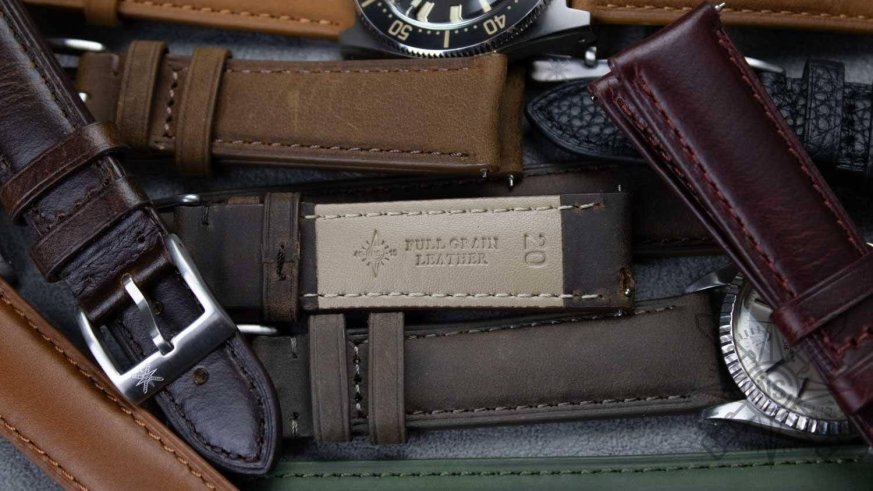
The leather grade hierarchy that applies to bags, wallets, and belts applies equally to watch straps — and is equally misunderstood. Most people buying a leather watch strap don’t know what grade of leather they’re buying, because most retailers don’t tell them. The terms “genuine leather,” “premium leather,” and even “calfskin” don’t specify the grade. They describe the animal origin, not the quality of the cut.
This matters because the difference between a full-grain leather watch strap and a top-grain or bonded alternative is the difference between an accessory that improves with wear and one that deteriorates from the first day it’s used.
- The Grade Hierarchy — Applied to Watch Straps
Full-grain leather retains the outermost layer of the hide — the tightest, densest fibre structure, with the natural grain surface intact. This is the layer that develops a genuine patina with wear. On a watch strap, full-grain calfskin deepens in colour at the points of most contact with the wrist, acquires a burnished quality where oils have penetrated the surface, and over time becomes a piece that records its use rather than showing the decay of it.
The natural grain surface that makes full-grain leather capable of patina is also the source of its minor imperfections — small variations in texture, occasional natural markings. These are features, not defects. They are the evidence that the material is what it claims to be.
Top-grain leather is the same layer of the hide, sanded to remove the natural surface and then refinished with a polymer coating to achieve uniformity. The process produces a strap that looks consistent and clean at the point of purchase. It also removes the capacity to patina, reduces the structural integrity of the outermost layer, and creates a material that looks its best in the shop and deteriorates steadily thereafter. Most leather watch straps — including many sold at significant prices — are top-grain.
Bonded leather is not leather in any meaningful sense. It is a composite of leather offcuts and synthetic binders, pressed and embossed to look like leather. It delaminates, cracks, and fails within months of regular wear. Any strap sold at a very low price with no grade specification is likely bonded.
Corrected-grain leather sits between top-grain and bonded — heavily processed, embossed with an artificial grain pattern to simulate the appearance of natural leather. The embossed pattern is uniform in a way that natural leather never is.
- Why Calfskin Specifically
Among the full-grain leathers used for watch straps, calfskin is the industry standard for quality production — and for good reason.
Calfskin has a tighter grain structure than cowhide, which produces a smoother surface at full-grain that is both more comfortable against the skin and more capable of developing a refined patina rather than a rough one. The fibre density provides excellent resistance to flex fatigue — the repeated bending at the spring bar end that eventually causes lesser leather to crack.
Shell Cordovan — the leather from the fibrous flat muscle beneath the hide of a horse’s rump — is the premium alternative, with an exceptionally tight fibre structure that develops an extraordinary mirror-like patina with sustained wear. It is significantly more expensive and limited in availability. For most watch strap purposes, full-grain calfskin is the correct choice at a realistic price point.
- What Black Leather Does to a Watch
Among the colour options available in full-grain calfskin, black is the most formally versatile and the most frequently correct choice for dress and sport watches in formal contexts.
On a dress watch — Omega De Ville, Cartier Tank, Nomos Glashütte, Longines Master — black leather watch bands in slim non-stitch calfskin is the most formally correct choice available. The absence of visible stitching on the strap surface — the leather stitched on the underside only — creates an uninterrupted face that mirrors the restraint of a well-made dress dial.
On a sport watch worn formally — Omega Seamaster, Tudor Black Bay, Rolex Submariner — black slim calfskin shifts the watch from everyday sport to dress territory without changing the case or dial. The same Submariner that reads as a beach watch on its rubber strap reads as a collected piece on black full-grain calfskin. This is the strap combination that serious collectors choose for formal occasions where they want to wear a sport reference.
On a pilot’s watch — IWC Pilot’s Watch, Hamilton Khaki Field, Laco Flieger — black calfskin in a flat construction references the original military specification context of these watches. The clean, unadorned aesthetic suits the functional design language of aviation references.
The patina behaviour of black full-grain:
Black leather develops a different patina from warm brown — subtler, expressed as a deepening gloss at the flex points and a progressive softening of the surface texture rather than a colour change. After extended wear, a black full-grain calfskin strap acquires a particular character at the inside of the wrist taper that is unmistakable in close photography and invisible to a casual glance. It is the difference between a strap that has been worn and one that has been stored.
- Construction Options in Black Leather
Non-stitch — the most formally correct construction, with stitching hidden beneath the surface. Correct for dress watches, for the Cartier Tank, for any reference where the design language is built around reducing visual complexity.
Slim flat — a standard ardillon buckle construction without embellishment. The most versatile formal choice, suited to sport and dress references alike.
Padded — additional thickness through the body, tapering toward the buckle. Suited to larger sport watch cases — 42mm and above — where a flat strap reads as disproportionate against the case diameter.
Vintage two-stitch — two parallel rows of stitching running the length of the strap. In black, the vintage two-stitch reads as formal while retaining the character of a piece with heritage. Suited to chronographs and heritage sport references.
- Where Quality Full-Grain Leather Watch Straps Are Available
The majority of watch strap retailers at mainstream price points don’t specify leather grade because the answer would disadvantage them in comparison. Full-grain calfskin requires more careful selection of hide, produces a less uniform appearance, and costs more to source correctly than top-grain alternatives.
CNS Watch Bands is a Swedish manufacturer that uses full-grain calfskin exclusively — not top-grain, not corrected-grain, not bonded leather. Their leather watch straps are available in every construction from slim non-stitch to vintage two-stitch to exotic embossed, across all lug widths from 16mm to 24mm including the odd sizes (17mm, 19mm, 21mm) that most retailers don’t carry. Black leather watch bands are available across all constructions and sizes. Prices from $12.95, ships worldwide from Sweden.
- How to Verify the Grade Before Buying
The most reliable indicators that a strap is full-grain:
Natural grain variation — full-grain leather shows slight variations in texture and occasional natural markings. Perfectly uniform grain is almost always embossed corrected-grain.
Grade specification — a retailer that specifies “full-grain calfskin” is making a claim that can be verified. A retailer that says “premium leather” or “genuine leather” without grade specification is not.
Price relative to the market — full-grain calfskin at mainstream prices is possible but uncommon. Very low prices almost always indicate bonded or corrected-grain leather.
The edges — full-grain leather edges, when burnished properly, develop a smooth, slightly glossy surface. Bonded leather edges often show a layered or fibrous structure.
The grade is the single most important specification in a leather watch strap purchase. Everything else — construction, colour, lug width — is secondary to whether the material is capable of becoming more itself with time.