
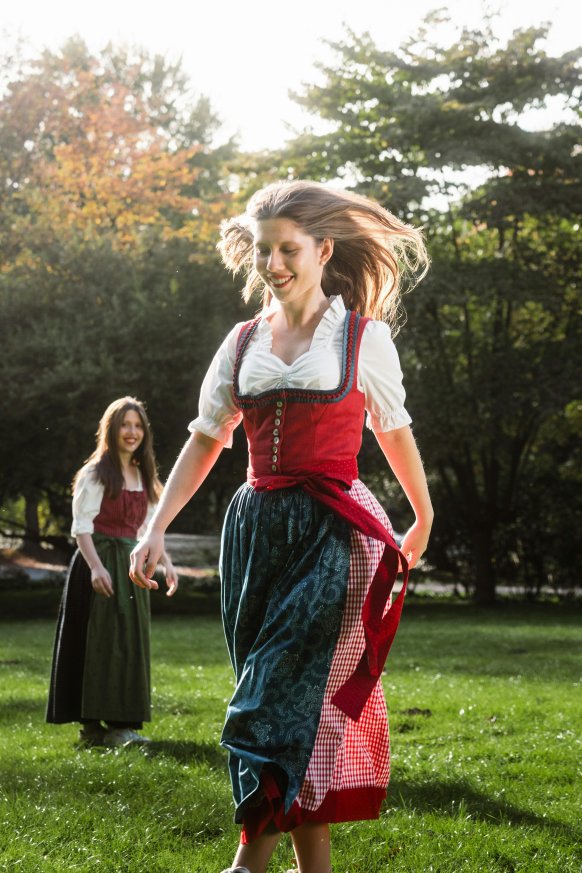
If you’ve ever stood at Oktoberfest squinting at a woman’s waist trying to decode a bow, you’re not alone and you’re definitely not the first. The Dirndl dress carries one of fashion’s most quietly communicated signals: a small, fabric bow that tells the world quite a lot without saying a word.
But here’s the thing. Most people get it wrong. Either they tie the bow wherever it’s comfortable, or they’ve heard a half-truth about what it means and run with it. This guide sets the record straight – no myths, no overclaiming, just the actual tradition explained clearly.
First, Let’s Talk About the Dirndl Dress Itself
Before decoding the apron, it helps to understand what makes the Dirndl dress more than just a garment .
The Dirndl originated in the Alpine regions of Austria, Bavaria, and the broader German-speaking world, where it was everyday workwear for rural women-practical, modest, and hardwearing. Over the centuries it evolved into regional festive dress, and today it’s one of the most recognizable garments in traditional European fashion.
A proper Dirndl dress consists of four components:
- The bodice – fitted, often structured, with a modest to low neckline
- The blouse – worn underneath, typically white and made of lightweight fabric
- The skirt – full and gathered at the waist, ranging from knee-length to floor-length
- The apron – tied at the front, and the piece that carries the social code
The apron is not a decorative filler. It is, in the language of Dirndl tradition, a communication tool.
The Bow: A Four-Position Code
The position of the apron bow corresponds to the wearer’s relationship status. This is not a modern invention or internet folklore, it has been a recognized tradition in Bavarian and Austrian folk culture for generations, though like all folk customs, it varies slightly by region and era.
Here is the standard reading:
Right Side – Taken
A bow tied on the right signals that the woman is in a committed relationship – engaged, married, or otherwise spoken for. In practical terms, this is the most common bow placement you’ll see at Oktoberfest among couples attending together.
If you see the bow on the right, the gentleman standing next to her probably already knows.
Left Side – Single
A bow tied on the left signals availability. The woman is single and, by choosing this placement, open to an approach. This is the traditional signal of an unmarried woman and in the crowded, festive atmosphere of a beer hall, it historically did a lot of social work very efficiently.
Center Front – Virgin or Young Girl
A bow tied directly at the center front traditionally indicates that the wearer is a young, unmarried girl, historically associated with virginity, though in modern usage it often simply signals youth or that the wearer is new to dirndl tradition and hasn’t made a deliberate choice.
This placement is less commonly seen among adult women at contemporary festivals.
Center Back — Widowed (or Working)
A bow tied at the center back is the most contextual of the four. Traditionally it indicated a widow, a woman no longer married but not actively signaling availability. In some regional interpretations, it also marked women who worked in service roles (waitresses, maids) as a practical placement that kept the apron from getting in the way.
At modern Oktoberfest, you’ll sometimes see servers wearing back-tied aprons for exactly this practical reason – though it still carries the widowed connotation in folk understanding.
What the Knot Type Says (The Detail Most People Miss)
Beyond position, the style of the bow matters in some interpretations:
- A neat, full bow suggests someone who dressed with intention and knows the tradition
- A half-bow or single loop sometimes signals carelessness or someone who simply doesn’t know the code
- A tight, flat knot with no loops can indicate the wearer has closed off the signal entirely, sometimes associated with being “off the market” in a less formal sense
This is where regional variation really shows up. In stricter traditional circles, the bow’s tidiness reflects the wearer’s care and propriety. In contemporary festival settings, most people are simply trying to keep their apron on through a long evening.
Common Mistakes And Why They Matter
Mistake #1: Tying Wherever Is Most Comfortable
Comfort is understandable. But if you’re wearing a Dirndl dress in a traditional setting – particularly in Bavaria or Austria, or at a genuine cultural event, an accidentally placed bow sends a signal you may not intend. Tying at the right is easy and neutral enough that it’s a good default for anyone unsure.
Mistake #2: Assuming Everyone Knows the Code
The Dirndl bow tradition is genuine, but it’s not universally known or universally practiced – even among Germans and Austrians. Younger wearers, tourists, and people dressing for fashion rather than tradition often don’t follow the positioning at all. Don’t read a bow placement as a definitive statement without cultural context.
Mistake #3: Treating It as a Strict Universal Rule
Folk traditions are regional, evolving, and informal. The bow code is real and widely recognized, but it is not a law, and interpretations vary. A woman in Munich may follow the code religiously; a woman wearing a Dirndl dress to a themed party in another country may have no idea it exists.
Mistake #4: Asking Someone to Explain Their Bow in Public
This is the social equivalent of asking someone their salary. If you know the code, you know. Keep it to yourself.
How to Wear the Bow If You’re Putting on a Dirndl Dress
If you’re wearing a Dirndl dress and want to engage authentically with the tradition:
- Choose your position deliberately. Left for single, right for taken.These are the two most socially active placements. Center back if you prefer no signal at all.
- Tie a proper bow. Two full loops, even tails, neat and centered within your chosen placement. It takes thirty seconds and makes the outfit look intentional rather than assembled.
- Match the apron to the dress. Traditional Dirndls pair contrasting aprons – dark dress with a lighter apron, or vice versa. Matching colors can work in modern styles, but the contrast is more traditional.
- Wear the blouse properly. The neckline of the blouse should be visible above the bodice. A visible, well-fitted blouse completes the look in a way that makes the whole outfit cohere.
- Don’t over-accessorize. The Dirndl dress is already structured and decorative. Jewelry should be minimal – small earrings, perhaps a simple necklace or a traditional brooch. Nothing that competes with the dress.
The Bigger Picture: Why This Tradition Endures
The Dirndl bow code has survived because it’s genuinely clever. In a context where strangers are gathered in close quarters – a festival, a beer hall, a market – a visible, fabric signal does the social work that would otherwise require conversation. It’s subtle enough to be deniable, visible enough to be legible, and elegant enough to be worth preserving.
What’s more, the Dirndl dress as a whole represents something worth understanding: the idea that clothing can carry meaning beyond aesthetics. The dirndl is festive, yes, but it’s also a piece of living folk culture. When someone wears it with knowledge of its conventions, they’re participating in something that stretches back centuries.
That’s a lot of communication from a small piece of fabric tied in a bow.
A Final Note on Respect
If you’re attending Oktoberfest or any traditional Alpine festival, the dirndl dress (and its male counterpart, the lederhosen) are cultural garments – not costumes. Wearing them thoughtfully, understanding their conventions, and engaging with the tradition respectfully makes the experience richer for everyone, including yourself.
Tie the bow deliberately. Know what it means. And if someone’s is on the right, keep walking.