
Most people only meet a tote bag at the finish line—photographed for a catalog, wrapped in tissue, resting on a shelf. What they never see is the long series of checks and quiet rejections that happen before a bag is allowed to leave the workshop.
At Bene Bags, we’ve learned that a well-made leather tote doesn’t come from one final inspection at the end. It comes from refusing to pass small defects at every stage of production. Here is the checklist that runs behind the scenes, from raw hide to finished bag. (The same principles apply to fabric totes, but leather is where the stakes—and the craftsmanship—are highest.)
- Hide Inspection: Saying No Before You Begin
Quality control starts before the first panel is cut. When a hide arrives, our cutters lay it flat under strong, even light and read it carefully—looking for scars, loose grain, stretch zones, and inconsistent thickness.
The goal isn’t to find a flawless hide; in full-grain leather, those barely exist, and natural marks are part of the material’s honesty. The real job is deciding where each panel can come from. High-stress areas—the base, handle anchors, corners, and side gussets—must be cut from the tight, dense fibers along the back and spine. Softer sections near the belly can serve low-stress panels. Any hide that can’t yield enough sound panels is rejected outright, and this single decision prevents more failures than any other step.
- Cutting and Grain Direction
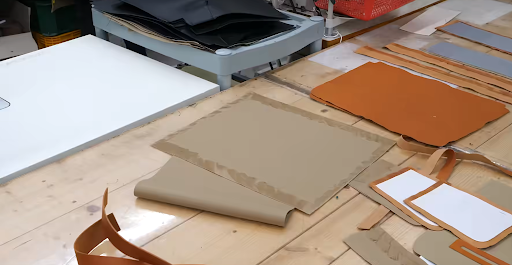
Once a hide is approved, the next checkpoint is the cut. Leather has more give in one direction than another. If a handle or large panel is cut along the wrong axis, it will stretch, twist, or lose shape within months.
We also gauge thickness at multiple points, because a hide is never perfectly uniform. Panels destined for the same bag are matched so the body, base, and straps feel like they belong together. Mismatched thickness is one of the most common reasons a bag looks fine but feels wrong in the hand.
- Skiving and Edge Preparation
Before assembly, edges where panels overlap or fold are skived—shaved thinner—so seams don’t become bulky or stiff. It’s a narrow margin: left too thick, the seam looks heavy; skived too thin, the fold turns weak and prone to tearing. Every skive is checked for an even taper and a clean transition between layers. This is a pass/fail moment, not a “good enough” one.
- Stitching: Counting What Most People Ignore
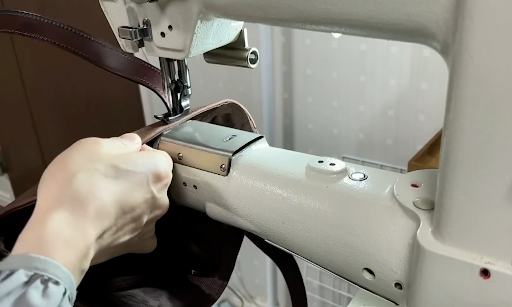
Stitching is one of the clearest signs of quality, and it’s where shortcuts hide best. Three things get checked on every bag:
- Stitch length: Too few stitches and the seam is weak; too many and you perforate the leather like a stamp, inviting tears. We hold a consistent count suited to the leather’s weight.
- Thread tension: Loose stitches snag and unravel; over-tight stitches cut into the leather and cause puckering. The lockstitch should sit balanced inside the material.
- Reinforcement at stress points: Handle bases, side seams, and bottom corners are backstitched, bartacked, or riveted. A bag may look beautiful, but if the stitching fails at the handle, the product fails.
- Handle Anchor Load Testing
This is the checkpoint that separates a tote lasting a decade from one failing in a year. The handles carry every pound you ever put in the bag, and the joint between handle and body is the most punished point in the entire design.
We physically load-test handle anchors, applying tension beyond normal daily use, watching for slipping, stitch strain, leather stretching, or rivet movement. Where appropriate, anchors are reinforced with rivets in addition to stitching—not because stitching is weak, but because redundancy is what “buy it for life” actually requires. A bag that fails at the handle has failed completely, no matter how lovely the rest of it is.
- Hardware and Interior Checks
Zippers, snaps, rivets, and rings are tested for action and finish. A shiny coating doesn’t guarantee strength, so we cycle zippers open and closed, confirm snaps close with confidence, and check that hardware is solid rather than plated pot-metal—usually the first thing to fail on an otherwise sound bag.
The inside matters too. The lining should sit flat without bubbling, glue residue, or unfinished seams, and internal pockets and corners should be clean and secure.
- Final Inspection and Packing
Only now do we look at the bag the way you will. Is it symmetrical? Do the handles sit at equal heights? Are the edges burnished evenly? Any loose thread, uneven edge, or glue mark sends the bag back rather than forward.
Packing is the last stage of quality control, not an afterthought. A leather bag may need shape protection, a dust bag, and moisture control so it arrives without pressure marks—because poor packing can ruin an otherwise flawless product.
Why the Checklist Matters
None of these steps are glamorous, and that’s exactly the point. A quality tote isn’t one heroic moment of craftsmanship; it’s the result of seven stations, each willing to reject a flaw.
So if you’re ever evaluating a bag—or the workshop behind it—the best question isn’t “What’s the price?” It’s “How is quality controlled before it ships?” The answer reveals far more than any catalog photo. It’s the standard we hold ourselves to at Bene Bags, one rejected hide and one reinforced stitch at a time, because a well-made tote should outlast the trend that sold it.