
A poker chip case does one boring job. It keeps 300 or 500 chips from sliding around your trunk and arriving at the host’s door as a pile of loose plastic. Leather cases do that job and look better doing it. The catch is that “leather” on a product page can mean four very different things, and only some of them survive a year of Friday nights.
Home poker usually starts on a screen. Plenty of players look at the newest online casino, enjoy the game, and then want real chips on a real table with friends. Fine. Then you hit the practical question: how do you haul several kilos of chips across town without wrecking them or your wrist?
Do the weight math first
Casino-style chips weigh somewhere between 11.5 g and 14 g each. Run the numbers:
| Chips | At 11.5 g | At 14 g |
| 300 | about 3.5 kg (7.6 lb) | about 4.2 kg (9.3 lb) |
| 500 | about 5.8 kg (12.7 lb) | 7 kg (15.4 lb) |
| 1,000 | about 11.5 kg (25 lb) | 14 kg (31 lb) |
That is before the case, two decks, buttons and dice. One retailer that redesigned its own aluminum case reported a loaded one close to 20 lb, and said the handle and latches took most of the strain. Keep that in mind, because the handle is what fails first on cheap cases. When you read leather case reviews, start there.
What “leather chip case” actually means
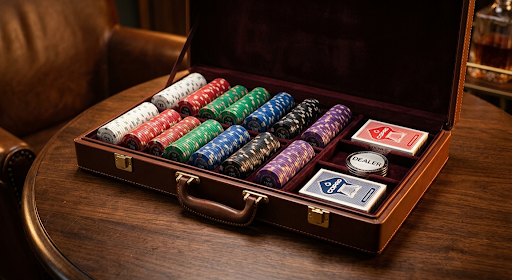
Leather-wrapped hard case. A wood or rigid frame covered in real leather, usually with metal latches and a stitched or riveted handle. Old brass-framed sets covered in tan leather, with suede-lined compartments, 300 chips and two decks of cards, still turn up on antique dealer sites. On the modern side, branded sets such as the ESPN poker club one come in a leather-covered case with a lock, and buyers mention how heavy it gets with 500 chips inside. This is the type to buy if the case travels weekly.
Faux or bonded leather. The budget route. Listings for 500-plus chip faux leather cases sit around $45, which is close to what a plain aluminum case costs. It looks good out of the box. Check the corners and the seam by the handle, because that is where the coating cracks first.
Hybrids. A leather interior inside a polycarbonate shell, or a slim case with a leather handle and a buckle closure. One 500-chip model of this kind is built around 43 mm chips and rides on a leather handle rather than leather all over. You get less leather, but the leather you get sits where your hand does.
Luxury pieces. Louis Vuitton’s Poker Box holds 300 ceramic chips (75 red, 50 blue, 50 green, 25 black, 100 white), a dealer button and two decks, in a box about 43 x 27 x 10 cm. Note the materials: monogram coated canvas with cowhide trim and a microfibre lining. That is a canvas box with leather accents, not a leather case. It makes a gift. It is not the case you toss in a friend’s garage.
How the types stack up on price and capacity
Real-leather cases are mostly sold inside chip sets or by small makers, so prices vary too much to pin down. The usual alternatives give you a baseline:
| Case type | Typical capacity | Price seen in listings |
| Aluminum with foam or wood tray | 300 to 1,000 | about $40 (300), $50 (600), $80 (1,000) |
| Solid wood | 300 to 500 | about $63 (300 oak or walnut), about $80 (500 walnut) |
| Faux leather hard case | 500+ | about $45 |
| Soft shell | 300 | about $40 |
Wood cases look great but are heavy, so players tend to keep them at home. Aluminum travels best on price alone. Leather is what you pick when the case has to look good on the host’s table too.
Check the chip size before the capacity
Most standard chips are around 39 mm across and 3 mm thick. Casino-style chips go up to 43 mm. A case sold for 500 chips will not hold 500 of the wider ones unless the listing says so. Read the diameter in the spec, then the count. A 300-chip case that fits your 40 mm chips is a better buy than a 500-chip case that fits only the thin ones.
What to test when the box arrives
- Pick it up full by the handle alone and hold it for half a minute with one hand
- Look at how the handle is anchored: screws or rivets into the frame beat a strap sewn into the leather skin
- Press each corner. The wrap should not lift or bubble
- Run a chip stack along the tray. Dense wood or a solid insert holds rows tight, while soft foam lets them rattle
- Sniff it. A strong chemical smell often points to a coated or bonded surface
- Close the latches with the trays loaded. If you have to force the lid, the lining is too thick or the tray too tall
- Make sure two decks, a dealer button and the blind buttons actually fit without crushing the cards
Which one to buy
For a weekly game at someone else’s place, go with a real leather-wrapped hard case that has a rigid tray and a handle fixed to the frame. For a shelf and the occasional trip, a hybrid with a leather handle does the job for less money. For a gift, a branded set looks the part. And if the budget is tight, a faux leather case is fine, as long as you inspect the seams before the return window closes.