
Bark, botanical, and weathered stone finishes suit wide men’s bands and hide daily wear. The three families, and the line between texture and costume.
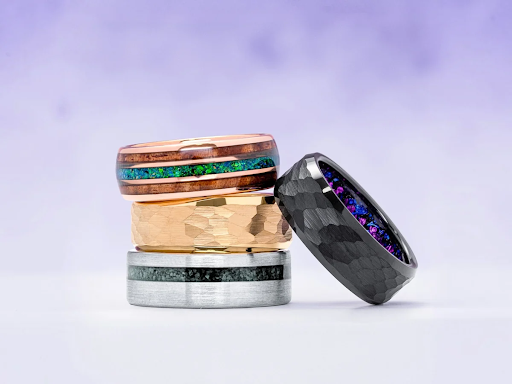
Of all the directions men’s ring design has taken in the last decade, the organic one is the least expected and the most durable. Bands textured to suggest bark, carved with foliage, or finished to resemble weathered stone now sit comfortably alongside the polished tradition. They work for a reason that has little to do with fashion and a lot to do with how texture behaves.
Why organic texture suits a men’s band specifically
Men’s bands are typically wider than their counterparts, which creates a problem: a large uninterrupted surface has to do something. Polish makes it reflective, brushing makes it flat, and organic relief makes it a landscape. The extra width that once made men’s rings monotonous turns out to be exactly what an organic texture needs in order to read as anything at all. On a very narrow band the same treatment simply disappears.
The three families
- Bark and wood. Vertical, irregular relief. The most three-dimensional of the group and the most obviously handmade.
- Leaf and botanical. Carved or engraved motifs running around the band. More graphic than tactile, and legible at close range.
- Stone and water. Hammered, dimpled, or rippled surfaces suggesting weathering rather than depicting anything. The most abstract and the easiest to wear.
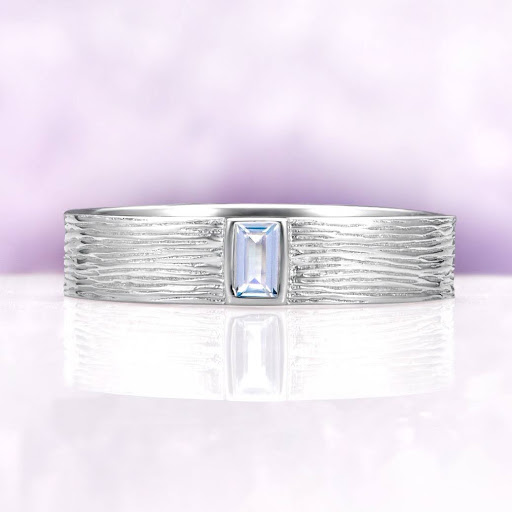
Bark relief gives a wide band a surface with depth rather than a surface with shine.
They handle daily life better than smooth surfaces
This is the practical argument, and it is a strong one. An organic texture is already irregular, so ordinary contact adds to a pattern rather than interrupting one. A polished band records every encounter distinctly; a bark-textured band absorbs the same encounters into its relief and looks essentially unchanged. For men whose hands work, this is not a stylistic preference but a functional advantage.
The line between texture and costume
Organic designs fail when they become literal. A band that depicts a recognizable scene, or that combines three different natural references at once, stops being a ring and starts being an illustration. The successful examples are abstract or nearly so: they suggest bark without being a tree, suggest water without being a wave. Restraint is what keeps the result wearable in a meeting rather than only at a wedding. Studios working carefully in this territory, the Aquamarise site among them, tend to keep the relief shallow and the reference singular for exactly this reason.
How they interact with metal tone
Cool metals emphasize the shadows in a relief surface, so bark and hammered textures read as more dramatic in silver and white gold. Warm metals soften the same relief, and yellow or rose tones make an organic texture look older and quieter. Neither is more correct. If you want the texture to be the main event, choose a cool tone. If you want it to be a subtlety noticed only at close range, choose a warm one.
Pairing with a stone
One protected stone in an organic band works particularly well, because the relief provides a field and the stone provides a fixed point within it. The stone should sit flush or bezeled rather than raised, both for durability and because a raised setting fights the low, continuous surface around it. More than one stone in a textured band generally reads as crowded, no matter how well each element is executed.
Where to see the range
Organic texture is difficult to mass-produce convincingly, which is why the best examples come from smaller workshops rather than large catalogs. A selection of nature inspired men’s wedding bands from an independent studio will usually show several relief treatments across the same profile, which is the clearest way to judge how much depth you actually want.
What lasts about it
Organic texture is not a trend in the way that a shape or a color can be, because it is not referencing a moment. It references material. That is why bands finished this way tend to look as coherent in a decade as they do now, and why the men who choose them rarely go back to a mirror finish.