
Leather furniture can make a game room sound less bare, but the material itself is rarely doing most of the acoustic work. Smooth, tightly finished leather is less porous than many woven coverings and should not be treated as a dedicated sound absorber. What usually changes the room is the complete object: cushions, foam, batting, frame, air spaces, shape, and placement. A deeply upholstered leather sofa may soften some reflections, while a thin leather pad fixed over a hard board may contribute very little.
Room acoustics depend on what happens after sound leaves its source. A 2025 explanation of acoustic design separates that behavior into reflection, absorption, and diffusion. Hard surfaces return sound into the room, porous materials take in part of its energy, and irregular forms scatter it in different directions. Too many reflections can blur speech and make short impacts seem sharper. Heavy absorption everywhere can make a room feel unnaturally flat. In practice, the aim is useful control rather than silence.
Different Games Produce Different Sound
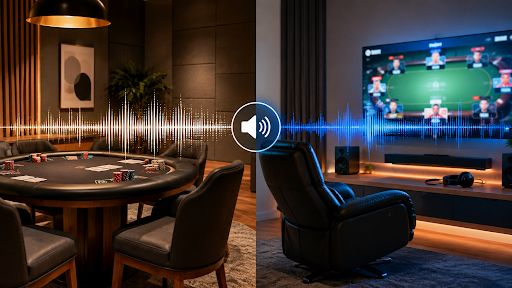
The acoustic character of a game room begins with its sounds, not the furniture in it. Around a casino-style table, conversation moves between seats, counters clack against each other, dice rattle when thrown, and chairs shift. Sound travels directly to the listener or reflects from tabletops, floors, windows, and walls, where overlapping reflections can blur voices and make repeated impacts feel busier.
The pattern changes when play moves to a screen. During online casino table games, card, wheel, and dice formats are represented through a display, so the physical sounds of objects moving across a shared surface largely disappear. Audio becomes concentrated around the device, speakers, and the person using them. Conversation may remain, but it no longer spreads evenly around a table. Reflections from a desk, the wall behind the screen, and hard flooring can therefore become more noticeable. A padded leather chair may absorb or scatter some sound, but it’s worth considering other elements too, especially if softening sounds is very important to you.
Physical table play may benefit from a rug beneath moving chairs, curtains near glass, and upholstered seating around the table. A screen-led setup may need more attention around speaker placement, the desk surface, and the wall opposite the device. Leather can suit either arrangement, but its acoustic contribution depends on padding, shape, and position, rather than the material alone.
Acoustics also matter between periods of activity. An Instagram post about taking an intentional offline break frames calm as part of leisure. In a game room, that means allowing conversation and game audio to end cleanly instead of lingering.
Judge the Whole Leather Assembly
A leather chair or sofa is an acoustic assembly. Its surface may be smooth, textured, perforated, or heavily coated. Beneath the leather may sit foam, loose filling, batting, timber, springs, or a rigid shell. Those hidden layers help determine how the object responds when sound reaches it.
Compare two pieces made with similar leather. A taut panel stretched over plywood presents a broad, firm face and may return much of the sound. A tufted chair with deep cushions adds depth, seams, and changing angles. Its padding and shape can absorb or scatter more energy, especially at higher frequencies. A person sitting in it changes the result again.
Placement often makes a surprising amount of difference as well. A rug can make a significant difference when placed near the center of a room with a hard floor. Curtains can reduce reflections from a large window. Moving a speaker away from a corner may improve clarity without rearranging any of the other furniture. If the room still carries a clear flutter or repeated echo, purpose-built panels can also help to diffuse the sound.
Absorption Is Not Soundproofing
Reducing reflections inside a room is acoustic treatment. Preventing sound from passing into another room is sound isolation. Furniture can influence what a listener hears within the space, but it will not seal a door gap, add mass to a partition, or stop vibration moving through the structure.
A 2026 guide to upholstery and acoustics explains that weighted sound-absorption values run from 0, meaning no measured absorption, to 1, representing total measured absorption under the relevant test. Those ratings apply to a specified material and test arrangement, not automatically to every chair or sofa. The source also distinguishes absorption from transmission and notes that layers, backing, and air gaps affect installed performance.
Keep the leather that suits the room’s appearance, comfort, and expected wear, then judge its acoustic contribution through the full construction. Listen for where sound starts, which surfaces it meets, and whether the problem is echo within the room or noise crossing a boundary.