
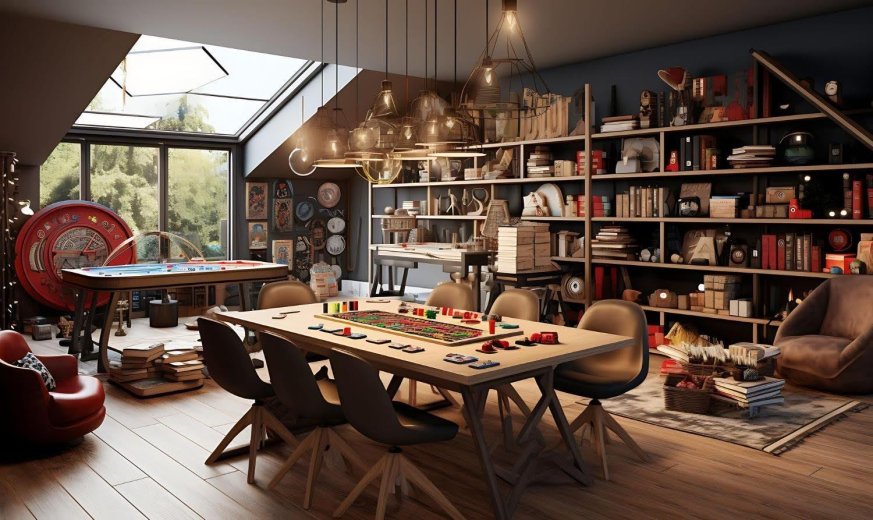
Image by thuynhungle99 on Magnific
Run a hand across the top of a Georgian card table and you learn two things before you have looked at it properly. The cloth has a direction. The leather at its edge has been compressed by two centuries of forearms resting in the same three places.
Furniture built for play is an unusual category. It has to survive being leaned on, spilled on, and closed and reopened tens of thousands of times, while presenting a surface engineered for a very specific coefficient of friction. The people who made these objects were solving a technical problem, not decorating a room, and the materials they settled on have barely been improved upon.
What Baize Actually Is
Almost everyone calls it felt. It is not felt.
Baize is a woven woollen cloth, napped after weaving to raise a short fibrous surface. Felt is matted rather than woven, and it would shed, pill and tear under a dealt card within a season. The distinction matters because the nap is the whole point. Wool fibres lie in a direction, and a card thrown across the grain behaves differently from one thrown with it. Dealers know this. So do the people who lay the cloth.
Billiard cloth is a different animal again: worsted rather than woollen, tightly spun, sometimes napped and sometimes deliberately not, because a ball wants a predictable roll and a card wants a controlled stop.
As for the green, the honest answer is that nobody knows for certain. Wool took certain dyes cheaply. Green is restful under candlelight. And the earliest tables were imitating lawns, which is where the games came from. All three explanations are probably partly true and none of them can be proved.
The Leather on a Card Table
Bridle leather is the material most associated with English game-room furniture, and its presence there is an accident of harness-making.
It is vegetable tanned, which takes months rather than the hours that chrome tanning requires, and then stuffed: worked full of tallows and waxes until the fibre structure is saturated. The result is dense, water-resistant, and capable of taking a burnished edge. It was developed to survive a horse. A card table is, by comparison, a gentle life.
You find it at the table edge, on cue-rack straps, on the seats of the accompanying chairs, and, in its thinner cousin skiver, laid across writing surfaces and tooled in gold. A well-made leather edge is skived to a feather, folded, and glued so that no step is detectable under a sleeve.
None of this survives digitisation, and there is no use pretending otherwise. A player at Mr Q slots online touches glass and nothing else. That is precisely why the physical objects have not disappeared. They offer the one thing a screen cannot, which is the hand’s memory of a surface, and a table that has kept a record of everyone who ever sat at it.
Joinery Built for Folding
The great card tables are defined by their hinges, which is not something you can say about many pieces of furniture.
A folding top means the frame must be rigid when open, compact when closed, and untroubled by either state. The finest English solution is the concertina action: a folding frame that draws out from within the carcass, supporting the opened leaf across its whole depth rather than on a swung rear leg. It is expensive, invisible, and the single most reliable indicator of quality on an eighteenth-century card table. Cheaper tables use a gate leg, which works, and looks it.
The tops themselves are usually mahogany, often veneered onto a stable secondary timber, sometimes with counter wells and candle stands inlaid at the corners. Collections such as those held by the Victoria and Albert Museum hold examples where the marquetry alone would have cost more than a labourer earned in a decade.
Billiard Tables and the Problem of Slate
Everything difficult about a billiard table follows from the bed.
The playing surface is slate, quarried, ground flat, and laid in three sections on a full-size table because a single slab would be unliftable and would crack. The three-piece bed must be levelled and the seams filled so that no ball can detect them. Beneath it sits a frame that is not really furniture at all but a structure, and above it a cloth stretched and tacked under tension that must be even in every direction.
The cushions are vulcanised rubber, a nineteenth-century arrival that transformed the game by making the rebound predictable. Before vulcanisation, cushions were stuffed with felt or list, and they died quietly within a year.
A full-size table weighs comfortably over a tonne. Anyone installing one in a first-floor room should be talking to a structural engineer, not a removals firm.
Caring for a Table That Outlives You
Brush baize in one direction, with the nap, using a soft brush and no vacuum. Vacuums lift the nap and eventually pull it out.
Leather wants very little. Occasional conditioning with a light dressing, applied sparingly, and no attempt to feed it into submission. Most damaged antique leather has been damaged by kindness.
Keep the table out of direct sun, which fades wool dye faster than anything else, and away from radiators, which will open every joint you own. Humidity between roughly forty and sixty per cent keeps timber and hide equally content.
Do all of that and the table will require re-clothing perhaps twice in your lifetime, which is a reasonable price for an object that will still be recording forearms long after everyone currently resting on it has stopped.