Personalized Guitar Straps Leather Showdown: Guitar Strap Customization Explained

Step on stage and, before the first chord rings out, eyes lock on the strap draped over your shoulder. It’s more than a safety harness—it’s a billboard for your style. Custom names, logos, even album art now cover premium hides, turning a humble accessory into a storytelling tool fans notice from the back row. This guide shows you how to pick leather that won’t crack mid-tour, what each personalization method does to looks and longevity, and which nine makers deserve your money in 2026. Let’s find the strap that feels like it was built for you.

How to choose a personalized leather strap

A few key facts prevent the heartbreak of a cracked strap mid-tour.

First, check the leather grade. Full-grain (or at least top-grain) keeps the hide’s natural fiber structure intact, so it flexes without tearing and ages into a rich patina. Lab tests and decades of player experience agree: a well-conditioned full-grain strap can last 30–50 years, outliving bonded leather that flakes in five or fewer, according to Szoneier Leather’s comparison of full-grain vs. genuine leather.

Next, pick a personalization method:

  • Embossing presses letters into the hide for a subtle, peel-proof finish.
  • Laser engraving burns artwork in with pinpoint accuracy and a darkened edge.
  • Embroidery stitches thread on top of leather, adding color and texture.
  • Printing lays full-color art over the surface, perfect for photos or graphics.
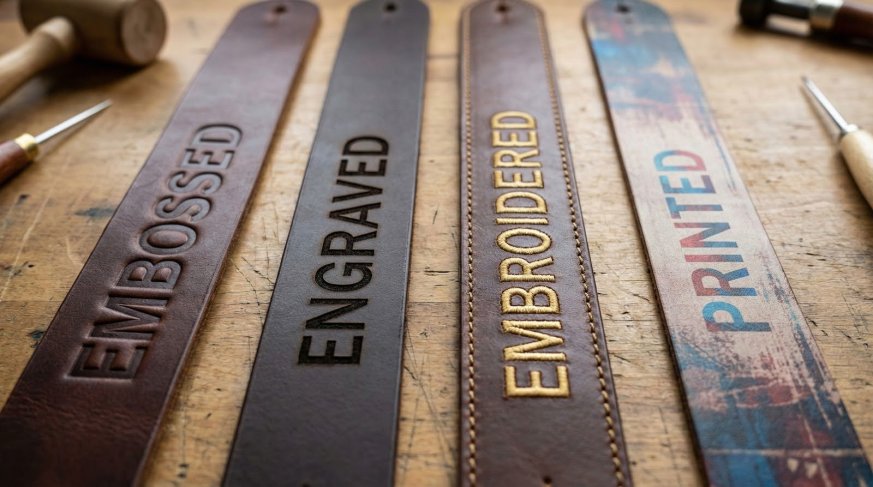
Match the finish to both your style and how hard you gig. Engraving and embossing merge with the leather itself, while embroidery and printing pop visually but show wear sooner.

Comfort matters. Wider straps—about 3 in (7.6 cm)—spread the load of a heavy Les Paul or bass and spare your shoulder on long sets. Padding helps, though a soft suede or microfiber lining often feels just as plush without extra bulk. Most quality straps adjust from 45 to 60 in (114 to 152 cm); taller players may need an extra-long option.

Style still counts. Decide whether you want vintage tooled western vibes, a sleek modern monogram, or a neon graphic that screams from the stage. Your strap will draw eyes, so make sure the look fits your musical persona.

Finally, balance price and lead time. Plan on $30–$60 for a ready-to-ship embroidered strap, $100-plus for boutique hand-tooled leather, and a wait of one to eight weeks depending on the artisan’s queue. Order early if a birthday gig or tour launch is circled on the calendar.

With these checkpoints locked in, you’ll breeze through the product profiles and choose a strap that feels tailor-made the moment you buckle it on.

1. Country Brook Craft Supply: build-it-from-scratch freedom

If you already have a strap sketched in your head—colors chosen, logo placed, maybe a repeating pattern—Country Brook helps you turn that concept into reality.

Country Brook has spent more than 21 years refining its process for dye-sublimated webbing and custom straps. Its Custom Design Straps and Webbing page lists over 20 sewing machines and monthly capacity of roughly 150,000 yards of sublimated webbing, so a single guitar strap is an easy lift—and even matching sets for a tour hardly dent the schedule. You upload artwork or text, pick the base material (nylon, cotton, polyester, or leather), and their team prints or laser engraves it with pro-grade equipment.
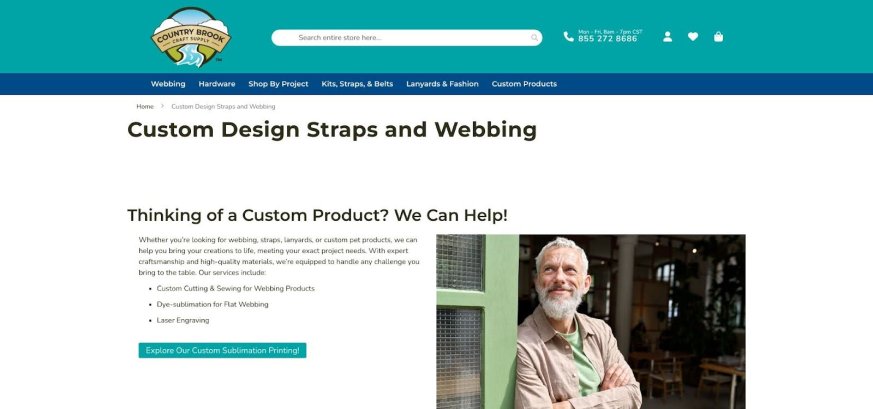
Country Brook custom guitar strap design and webbing production page screenshot

Because everything happens under one roof, quality stays high. Heavy-duty stitching, reinforced ends, and load-bearing hardware come standard, so the strap feels stage-ready out of the box.

Prices are quoted per project. A simple printed nylon strap often lands around $40–$60, while a leather build with engraving typically starts near $90. Turnaround varies with artwork complexity but usually beats small artisan shops, making Country Brook ideal when you need matching straps for a tour or just one that looks exactly like the design in your mind.

2. Art Tribute 3 in personalized strap: quick, affordable, gift-ready

Need a custom strap by next weekend and don’t want to drain the gear budget? Art Tribute’s embroidered leather option solves both problems.

The strap arrives soft and padded, measures 3 in (7.6 cm) wide, and comes boxed for gifting. At checkout you enter a name—up to 12 characters—and choose a thread color. Automated embroidery stitches crisp lettering that pops against classic black or brown leather, achieving a custom-shop vibe without the wait.

Art Tribute personalized 3-inch embroidered guitar strap product page screenshot

The extra width and padding balance heavier electrics. Length adjusts from 37 to 62 in (94 to 157 cm), so players of nearly any height find a comfortable spot. Art Tribute also includes strap locks, buttons, and picks, turning a roughly $45 purchase into a full accessory kit.

If you’re buying a first personalized strap, or matching straps for the whole band, this model delivers style fast while keeping costs low.

Step on stage and, before the first chord rings out, eyes lock on the strap draped over your shoulder. It’s more than a safety harness—it’s a billboard for your style. Custom names, logos, even album art now cover premium hides, turning a humble accessory into a storytelling tool fans notice from the back row. This guide shows you how to pick leather that won’t crack mid-tour, what each personalization method does to looks and longevity, and which nine makers deserve your money in 2026. Let’s find the strap that feels like it was built for you.

How to choose a personalized leather strap

A few key facts prevent the heartbreak of a cracked strap mid-tour.

First, check leather grade. Full-grain (or at least top-grain) keeps the hide’s natural fiber structure intact, so it flexes without tearing and ages into a rich patina. Lab tests and decades of player experience agree: a well-conditioned full-grain strap can last 30–50 years, outliving bonded leather that flakes in five or fewer, according to Szoneier Leather’s comparison of full-grain vs. genuine leather.

Next, pick a personalization method:

  • Embossing presses letters into the hide for a subtle, peel-proof finish.
  • Laser engraving burns artwork in with pinpoint accuracy and a darkened edge.
  • Embroidery stitches thread on top of leather, adding color and texture.
  • Printing lays full-color art over the surface, perfect for photos or graphics.

Match the finish to both your style and how hard you gig. Engraving and embossing merge with the leather itself, while embroidery and printing pop visually but show wear sooner.

Comfort matters. Wider straps—about 3 in (7.6 cm)—spread the load of a heavy Les Paul or bass and spare your shoulder on long sets. Padding helps, though a soft suede or microfiber lining often feels just as plush without extra bulk. Most quality straps adjust from 45 to 60 in (114 to 152 cm); taller players may need an extra-long option.

Style still counts. Decide whether you want vintage tooled western vibes, a sleek modern monogram, or a neon graphic that screams from the stage. Your strap will draw eyes, so make sure the look fits your musical persona.

Finally, balance price and lead time. Plan on $30–$60 for a ready-to-ship embroidered strap, $100-plus for boutique hand-tooled leather, and a wait of one to eight weeks depending on the artisan’s queue. Order early if a birthday gig or tour launch is circled on the calendar.

With these checkpoints locked in, you’ll breeze through the product profiles and choose a strap that feels tailor-made the moment you buckle it on.

1. Country Brook Craft Supply: build-it-from-scratch freedom

If you already have a strap sketched in your head—colors chosen, logo placed, maybe a repeating pattern—Country Brook helps you turn that concept into reality.

Country Brook has spent more than 21 years refining its process for dye-sublimated webbing and custom straps. Its Custom Design Straps and Webbing page lists over 20 sewing machines and monthly capacity of roughly 150,000 yards of sublimated webbing, so a single guitar strap is an easy lift—and even matching sets for a tour hardly dent the schedule. You upload artwork or text, pick the base material (nylon, cotton, polyester, or leather), and their team prints or laser engraves it with pro-grade equipment.

Country Brook custom guitar strap design and webbing production page screenshot

Because everything happens under one roof, quality stays high. Heavy-duty stitching, reinforced ends, and load-bearing hardware come standard, so the strap feels stage-ready out of the box.

Prices are quoted per project. A simple printed nylon strap often lands around $40–$60, while a leather build with engraving typically starts near $90. Turnaround varies with artwork complexity but usually beats small artisan shops, making Country Brook ideal when you need matching straps for a tour or just one that looks exactly like the design in your mind.

2. Art Tribute 3 in personalized strap: quick, affordable, gift-ready

Need a custom strap by next weekend and don’t want to drain the gear budget? Art Tribute’s embroidered leather option solves both problems.

The strap arrives soft and padded, measures 3 in (7.6 cm) wide, and comes boxed for gifting. At checkout you enter a name—up to 12 characters—and choose a thread color. Automated embroidery stitches crisp lettering that pops against classic black or brown leather, achieving a custom-shop vibe without the wait.

Art Tribute personalized 3-inch embroidered guitar strap product page screenshot

The extra width and padding balance heavier electrics. Length adjusts from 37 to 62 in (94 to 157 cm), so players of nearly any height find a comfortable spot. Art Tribute also includes strap locks, buttons, and picks, turning a roughly $45 purchase into a full accessory kit.

If you’re buying a first personalized strap, or matching straps for the whole band, this model delivers style fast while keeping costs low.

3. StrapGraphics custom straps: your art, front and center

Some players want more than a name; they want the whole strap to double as album art. StrapGraphics makes that possible with an online builder that feels like a design app for guitarists.

Upload a photo, layer text, adjust colors, and preview the result in real time. The company then prints the design edge to edge on durable polyester or leather, sealing the colors so they resist fading under stage lights.

StrapGraphics custom guitar strap designer and printed strap gallery screenshot

Choose bright vegan poly webbing for maximum color vibrancy, or select a leather base for a traditional feel with a printed top layer. Either way, sturdy leather ends keep the strap secure gig after gig.

Plan on spending $60–$100 and waiting two to three weeks while your creation travels from the Oregon workshop to your doorstep. For bands rolling out new artwork or solo artists who want lyrics visible before the first chord, StrapGraphics turns a strap into a moving billboard.

4. Double Treble: embroidery built to tour

Double Treble feels like stepping into a custom suit shop, except the tailor plays guitar and knows where straps fail after a year on the road. Each order starts with thick, vegetable-tanned leather that smells like a new amp and breaks in like favorite boots.

Personalization happens with thread, not lasers. Choose bold block letters or ornate script, pick colors from mild to wild, and let the shop stitch your name or logo flush with the leather so nothing snags on stage clothes or cable runs.

Function matches the showpiece look. The broad shoulder segment, roughly 3 in (7.6 cm) wide, plus optional padding, keeps a heavy bass balanced. Precise length slots land your instrument exactly where you like it, avoiding awkward between-hole compromises. Hardware and stitching are tour-grade; players report straps still going strong after hundreds of load-ins.

Plan to spend $110–$150 and wait two to four weeks while the small U.S. team finishes your strap. If you are done replacing bargain options every season, Double Treble delivers a piece that will age alongside your set list.

5. Leathersmith Designs: top-shelf craft for a lifetime of gigs

Picture the scent of a vintage guitar shop—aged mahogany and worn leather. That vibe arrives in every Leathersmith box.

The process starts with full-grain cowhide thick enough to stop a pick in flight, then adds a lining of soft garment leather or optional memory-foam padding. Every letter or motif is carved, inlaid, or tooled by hand; no rushed laser shortcuts, so the design settles into the hide like a tattoo.

Leathersmith Designs hand-tooled full-grain leather guitar strap official product photo

Customization is wide open. Want initials in contrasting burgundy, a scroll of western tooling along the edges, and conchos that match your Telecaster? Their script, inlay, and classic series offer templates, yet the shop still welcomes one-off ideas.

Expect to invest $150–$250 and wait three to six weeks while the Canadian team finishes your strap. Slip it over your shoulder and the leather molds to you, softening show after show until it feels invisible.

For players who see gear as a long-term partner, Leathersmith delivers a strap you will retire with, not replace.

6. Brookwood Leather: vintage western soul, built like a tank

If your playlist leans toward Bakersfield twang or ’50s rockabilly, Brookwood Leather fits right in. Each strap looks lifted from an old honky-tonk wall: hand-tooled floral borders, rich saddle browns, and optional conchos that catch stage lights. Most builds measure about 2.75 in (7 cm) wide, a comfortable span for electric guitars and basses.

The craft stays old-school. One artisan cuts, tools, dyes, and stitches every piece, then sizes it to your preferred playing height. You can add your name carved into the center panel or stamped near the tail, paired with a classic buckle or lace adjustment that completes the vintage vibe.

Two layers of vegetable-tanned leather are stitched together, so the strap rests supple on your shoulder yet refuses to stretch out of shape. Gig for years and it only looks better, the tooling darkening as sweat and stage dust settle into the grooves.

Pricing lands around $100–$150, depending on complexity, and the lead time runs a few weeks to a couple of months, especially near the holidays. The wait pays off if you want a strap that earns compliments before you even plug in.

7. Jodi Head name straps: loud, proud, and born in NYC

Some accessories whisper; Jodi Head straps shout your name in block letters tall enough for the cheap seats. Handmade in a Lower East Side workshop, they have ridden shoulders from Springsteen to tiny Brooklyn stages with the same unapologetic confidence.

Customization stays simple yet bold: up to eight leather letters in a strong, all-caps font stitched onto a contrasting base. Add stars, lightning bolts, or music-note icons at each end if you want extra flair. The result stands out under stage lights and camera flashes, delivering instant name recognition.

Jodi Head custom name guitar straps page screenshot with bold block letters

Behind the flash is serious build quality. Thick leather, soft garment backing, and precise stitching handle nightly sweat and cable snags, while a 2.5 in (6.4 cm) width eases shoulder strain. Break it in like a new pair of boots, then forget it is there.

Lead time runs about one to two weeks, and prices typically range from $160 to $220 depending on extras. For performers who want the crowd to remember their name before the first chorus, Jodi Head delivers attitude on arrival.

8. Holtz Leather “The Legend”: a strap that tells a story

Holtz Leather treats gear like future family hand-me-downs. Each strap starts with full-grain American hide, cut to a generous 2.5 in (6.4 cm) width and already carrying that vintage guitar-case scent. Set it on your shoulder and the workmanship is obvious.

Personalization stays understated. Holtz can laser engrave or hand emboss the name you choose, often the guitar’s nickname, low on the strap so it peeks out but never distracts. The lettering sits deep and permanent, offering a subtle signature that catches light at the right moment.

Comfort improves with every show. The thick leather softens, edges round off, and the strap molds to your shape like a well-worn glove. There is no extra padding, just honest material that breaks in, not down.

Plan on spending about $120–$160 and waiting two to three weeks. Each strap arrives boxed for gifting with a card that shares the “Legend” story. Present it to a graduating music student, a touring partner, or yourself on album-release day; the sentiment feels as solid as the build.

9. Ozark Mountain Leather: handmade charm, Etsy ease

Ozark Mountain blends small-shop skill with the simplicity of an online cart. Browse the listing, pick one of three leather colors, choose from five fonts, and add up to ten letters plus a decorative stamp. In minutes you lock in a design that a single maker will hand-tool, dye, and sew in rural Missouri.

At 2.75 in (7 cm) wide with a suede back, the strap hugs your shoulder without sliding. Two stitched layers, never glued, keep the body from stretching while the surface ages into a mellow patina. Customers often open the box and feel they bought a strap worth far more than the roughly $90 price tag.

Turnaround runs three to four weeks most of the year, and the shop posts weekly production updates so you know exactly where your order stands. Need multiple straps—matching names for a wedding band, for example? Bulk discounts apply automatically.

For players who love handmade goods but want to skip long custom-shop email threads, Ozark Mountain delivers a personal, gift-ready strap with just a few clicks.
 

Credit Score 101: Myths Vs. Facts You Need To Know

Credit Scores: Small Number, Big Impact

A credit score summarizes how a person has handled credit accounts over time. Lenders and other decision-makers use it to estimate the likelihood that someone will pay obligations as agreed.

Because the score is built from report data, misunderstandings can lead to mistakes. Separating myths from facts keeps attention on what matters most.

In Short: Most improvements come from steady habits, not dramatic moves.

Myth Vs. Fact: What a Credit Score Really Measures

Myth: A credit score measures personal character. Fact: It is a statistical snapshot based on credit-report information, not a judgment about someone’s value.

Some myths treat a credit score as permanent, but it can change as quickly as classic 777 slots when new data is reported.

Credit Score Ranges and “Good” Benchmarks

Many people assume there is one universal cutoff for a “good” score. In practice, models differ, and lenders set different standards for different products.

Instead of chasing one number, track the direction of change and what likely drove it. That makes it easier to spot patterns worth fixing.

Tip: Compare scores only when the source and model are the same.

Where the Data Comes From (and What Doesn’t)

Scores are built from credit-report data like payment history, revolving balances, and account age. They are not built from income, job title, or the balance in a bank account.

This is why similar incomes can still pair with different scores. The score mostly reflects on-time payments and how heavily available credit is used.

Often Included in Credit ReportsNot Used in Most Score Formulas
On-time and late paymentsIncome or salary
Credit card balances and limitsBank account balances
Account age and mixMarital status

Common Myths About Checks, Cards, and Closing Accounts

Confusion often comes from mixing up “soft” checks (like checking a personal score) with “hard” inquiries tied to new applications. Another myth is assuming a zero balance is always best, without thinking about utilization.

These quick reminders keep routine decisions in context. They can prevent overreacting to normal score changes.

  • Myth: Checking a personal credit score lowers it.
  • Fact: Reviewing personal credit information is typically a soft inquiry and does not affect the score.
  • Myth: Closing old cards always helps.
  • Fact: Closing an older account can reduce available credit and shorten average account age, which may lower a score.
  • Myth: Carrying a balance builds a score faster.
  • Fact: Carrying a balance is not required to build credit history, and higher revolving balances can increase utilization.

What Actually Moves the Number

Credit scoring formulas vary, but most lean on the same core categories. Understanding the categories is more useful than chasing a single shortcut.

Payment History Still Leads

Late payments can have an outsized effect because they signal missed obligations. Reminders or autopay for minimum payments can help prevent accidental slips.

Credit Utilization Is About Ratios

Utilization looks at how much revolving credit is used compared with available limits. Lower utilization is generally better, especially when it stays consistent across months.

Time and Variety Matter

Older, well-managed accounts can support a stronger profile because they show longer patterns. A mix of account types may help, but only when they fit an actual need.

New Credit Has a Short-Term Effect

Applying for new credit can add hard inquiries and lower average account age. Those effects often fade with time when accounts are managed well.

Simple Habits That Beat Quick-Fix Promises

Many “instant boost” claims rely on half-truths, like the idea that one payment will transform a score overnight. In reality, credit-building is a pattern of steady consistency.

Practical steps include paying on time, keeping revolving balances manageable, and spacing out applications. Checking reports for errors can also help, since inaccurate items can drag a score down.

Checklist: Pay on time, keep utilization low, and review reports for mistakes.

Bottom Line: Focus on What You Can Control

Credit scores respond to information that can be updated, so “secret rules” tend to disappoint. The clearest path is usually the simplest: pay on time, use credit lightly, and give good habits time to work.

For personalized help, a nonprofit credit counselor or a trusted financial professional can explain options and tradeoffs. Checking reports regularly also makes it easier to spot identity-theft issues early.

How Media Coverage Helped Sweepstakes Casinos Go Mainstream

From Niche Hobby to Headline Topic

Sweepstakes casinos used to be something many people only heard about in niche forums and chat groups. Over the last few years, they started showing up in broader stories about online entertainment, app policies, and state-by-state rules. Once a topic hits regular news feeds, new readers look for simple answers and clear definitions.

That is where media coverage matters most: it turns inside jargon into plain language and sets expectations for how the category works. It also puts the spotlight on both the fun, social side and the questions that come with fast growth.

In Short: More coverage meant more people understood the basics. That made it easier for the category to reach beyond early adopters.

Explainer Journalism Made the Model Easier To Understand

Early headlines often treated sweepstakes casinos as a confusing “loophole,” which left readers unsure what they were looking at. As more reporters published explainers, the conversation shifted toward concrete details like “no purchase necessary” entry options, dual-coin systems, and where the official rules live.

Once those explainers started pointing to real examples, it became easier for curious readers to check claims for themselves. For instance, the American Luck online casino homepage shows how Gold Coins and Sweeps Coins are used, along with links to sweepstakes rules and key terms. That kind of transparency helps the category feel less like an insider secret and more like a product many people can evaluate.

Another change was consistency. When multiple outlets use similar definitions, readers can compare coverage instead of trying to translate every article from scratch.

The Story Angles That Pulled New Audiences In

Media attention did not grow in a straight line. It expanded because different story angles kept pulling sweepstakes casinos into wider conversations.

Legality, Compliance, and Consumer Questions

Coverage increasingly focused on how state regulators and lawmakers view sweepstakes-style platforms. Reports about cease-and-desist letters, proposed bans, and enforcement debates sparked new waves of searches.

Big Platforms and Ad-Policy Changes

Another driver was policy changes from major online platforms that control ads and distribution. When rules shift, the topic moves from trade press to mainstream tech and business coverage.

Social Media Amplified Traditional Coverage

News articles rarely stay on the page where they were published. Creators summarize them, viewers debate them, and algorithms push the most engaging clips to new audiences. That sharing loop can make a single explainer feel like a “trend” overnight.

  • Quick Summaries: Short videos translate long articles into a few key points.
  • Live Q&A: Viewers ask basic questions in real time, which forces clearer explanations.
  • Search Spikes: Viral posts send people to look up definitions and official rules.
  • Community Checks: Players compare notes about availability, age limits, and rule details.

Social sharing can also blur the line between reporting and promotion. Disclosures and source links matter, especially when an account is repeating claims without context.

How Headlines Changed What “Mainstream” Means

“Mainstream” coverage is not the same as “positive” coverage. Many of the biggest stories were driven by scrutiny, legal questions, or policy changes that affected visibility.

The practical impact is that readers now see more balanced reporting, with a clearer sense of what to check before trusting a claim. A quick way to read these stories is to notice the trigger and then look for the concrete “what changed” section.

Coverage TriggerWhat Readers Usually Learn
State bills or enforcementWhich jurisdictions are tightening rules and what language they use
Platform policy updatesHow advertising, app listings, or age gates may shift
Explainer or “how it works” featuresDefinitions, coin terminology, and the sweepstakes entry framework

What To Watch Next

Sweepstakes casinos are likely to stay in the news because the rules are still evolving and coverage tends to follow conflict. Expect more stories that compare state approaches, track enforcement actions, and explain new platform policies as they appear.

For readers, the safest approach is to treat headlines as a starting point, not a final verdict. Checking official rules, eligibility details, and clear disclosures can prevent misunderstandings.

Takeaway: Media coverage made the category easier to find. It also raised the bar for clarity and accountability.

CasinosAnalyzer Guides Players Toward Fair Play and Safe Casinos

Casino players often discover that fairness and safety are not guaranteed simply because a site looks professional or promotes large bonuses. Many platforms present polished marketing, but the reality behind their payout behavior, identity verification practices, and customer support can be far different. Players need a way to separate genuine reliability from surface-level promises.

CasinosAnalyzer fills that need by examining hard data, historical records, game environments, and operational patterns to reveal how casinos truly behave. Its team reviews licensing, dispute outcomes, game fairness indicators, and internal policy changes to create a clear picture of each casino’s trustworthiness. By doing so, CasinosAnalyzer guides players toward safe decisions and helps them avoid pitfalls that often cost money and time. Here, users can also access current free offers, including free chips, via the link https://casinosanalyzer.com/free-spins-no-deposit/free-chips

How CasinosAnalyzer Identifies Fair Casino Environments

Fair play begins with measurable evidence. CasinosAnalyzer studies thousands of data points to determine whether a casino maintains consistent payouts, transparent rules, and stable operational behavior. One of the core elements in its evaluation process is tracking long-term payout performance. A casino may claim to operate at a competitive RTP range, but these advertised values often represent theoretical numbers rather than real operational averages. 

CasinosAnalyzer gathers monthly payout snapshots, compares them against historical records, and calculates fluctuations. If a slot category shows a drift from 96% toward 93% over a six-month span, CasinosAnalyzer highlights the trend so players understand what has changed. This type of detailed monitoring reveals whether a casino adjusts its game availability to affect expected returns.

Game fairness requires deeper attention. Providers often release updated versions of slots that alter volatility or prize distribution. CasinosAnalyzer conducts controlled test sessions to document how a game’s behavior aligns with published specifications. If real-world results deviate significantly from expected hit frequency or bonus round probability, that discrepancy becomes a warning sign. Players benefit because they gain insight into how transparent the casino is about its game offerings.

Fair environments also depend on clear dispute handling. CasinosAnalyzer examines complaint patterns, response times, and whether a casino consistently resolves issues within reasonable timeframes. When a casino handles identification checks within 24 hours and payouts within 48 hours, the stability is visible. When delays stretch across weeks, CasinosAnalyzer documents them and adjusts trust scores to reflect real performance, not promotional claims.

This approach ensures players know exactly what type of environment they are entering. Instead of relying on generic labels like “fair” or “reputable,” CasinosAnalyzer backs every conclusion with measured behavior.

How CasinosAnalyzer Helps Players Avoid Unsafe Casinos

Unsafe casinos do not always appear dangerous on the surface. Many operate with enticing bonuses, modern interfaces, and aggressive advertising. The real risks become visible only when players attempt to withdraw, dispute a charge, or check a casino’s licensing legitimacy. CasinosAnalyzer analyzes safety risks by correlating data from regulatory reports, user complaints, payout time records, and historical policy changes.

One of the strongest indicators of unsafe behavior is inconsistent cash-out performance. CasinosAnalyzer maintains statistical withdrawal timelines based on verified user submissions and internal tests. In 2024, casinos with a high incidence of stalling requests averaged payout delays of 96 to 160 hours, while stable casinos processed standard withdrawals within 6 to 30 hours. This contrast helps players identify sites likely to withhold funds or complicate the verification process.

Support behavior further exposes unsafe platforms. CasinosAnalyzer performs live scenario tests to evaluate how support teams respond to urgent issues such as locked accounts or deposit reversals. Casinos with evasive or contradictory answers often correlate with poor dispute outcomes. Players benefit from knowing which casinos treat problem resolution seriously and which avoid responsibility.

CasinosAnalyzer protects players by presenting this information in plain language supported by reliable data. It prevents users from entering risky situations by showing warning signs that most players would not identify independently. In a market filled with misleading claims, this protection becomes invaluable for safe play.

How CasinosAnalyzer Promotes Transparency and Real Accountability

Transparency and accountability are essential for long-term trust. CasinosAnalyzer promotes both by documenting how casinos evolve over time rather than presenting a static snapshot. Casinos frequently adjust bonus policies, payout terms, and withdrawal limits, sometimes without explicit announcements. CasinosAnalyzer monitors these changes by comparing archived policy versions, tracking player reports, and maintaining a chronological record of modifications. When a casino reduces its withdrawal limit from $5,000 to $1,500 or introduces new identification rules, the shift is added to its public profile.

Payout tracking enhances accountability. CasinosAnalyzer compiles verified payout durations from a large data pool. Because this data is updated continuously, players see whether a casino is improving or deteriorating. For example, a casino that processed payouts in under two hours in early 2023 but expanded processing time to twelve hours in late 2024 signals operational pressure or internal restructuring. By presenting these trends, CasinosAnalyzer empowers players to choose casinos that maintain consistent standards.

Importantly, casinos cannot manipulate or purchase adjustments to their ratings. CasinosAnalyzer’s policies prevent operators from influencing the outcome of reviews. If a casino requests a correction, the platform verifies the claim through regulatory documents, payment provider confirmations, and technical logs before making any update. This strict verification protects the player and ensures that accountability remains genuine and measurable. Key elements that support transparency and accountability:

  • Continuous tracking of changes in bonus terms, payout rules, and withdrawal limits
  • Archiving and comparing historical policy versions for each casino
  • Recording player reports in chronological order to identify patterns
  • Monitoring operational shifts such as new ID requirements or lowered withdrawal caps
  • Compiling verified payout durations and displaying performance trends
  • Detecting improvements or declines in casino processing speed over time

Through these methods, CasinosAnalyzer turns transparency into a practical advantage for players who seek safe, predictable casino experiences.

How Leather Defines the Value of High-End Bags

Value has never been the question of price in the realm of luxury bags. Instead, it is an overall vision created with the help of materials, craftsmanship, design, and brand philosophy. In this system, leather is not merely a raw material that is utilized in making the bag but it is a matter of life and death that defines the position of the products, brand reputation and market identification. The value of a bag to a large extent is characterized by leather.

High-End Bags Begin with Premium Leather

The initial perception of a high-end bag by a consumer can be determined by touch and sight. Leather is the closest and most compelling medium of value. These leathers are usually of rare and well-managed areas throughout the globe: e.g. French calfskin, with a fine and soft grain and evenly spread pores, or vegetable tanned leather of Italy, smoothed with natural vegetable tannins that form an amber hue of the leather over time. 

These leathers have slight variations on top of their unique textures, feeling and natural luster. It is this personalized nature that makes each bag appear to have a non-replicability. The material evolution of leather as compared to the uniformity of synthetic materials is more likely to conform to the ideas of sophistication, luxury, and quality. To the high-end customers, leather does not just constitute a material option, it is a way of life and a statement of individual principle.

Leather Determines a Bag’s Lifespan and Long-Term Value

Leather has natural benefits in the aspects of durability and longevity. The leather is of good quality, which incorporates the quality of durability with strength, and when well taken care of, over time, it has a peculiar patina that adds aesthetic depth to the bag. A leather bag can still bring out new layers of beauty even many years after being used. The process of aging contributes to the concept of long-term companionship and enables the bag to be used as a source of individual narratives. 

Commercially, the extended lifecycle of the product will result in an increase in value, reduced replacement rates, and an attachment to consumers. A bag that can be worn over many years or even make a signature of personal items usually becomes a very strong source of brand loyalty. This is why most custom bag manufacturers focus more on the practicality and the timeless nature of their products rather than the temporary nature of their trends when designing them.

Leather as the Foundation of High-End Craftsmanship and Design

The flexibility and moldability of leather allow the designers and craftsmen to achieve complicated forms and elegant details in a very accurate manner. Outstanding tanning and manufacturing processes also increase the price of leather. Expensive leathers can be tanned over months; vegetable tanned leather can take several months to tan, including soaking, drying, and curing of the leather to remove impurities without losing the strength and breathability of the leather. 

Consequently, leather behaves in the same way during the entire production process, be it in three dimensional fittings, smooth edgework, or the purity of stitch density. The high quality leather enables designers to go beyond the rigidity of formal constraints in cutting, stitching and shaping, and to create creative ideas into viable and lasting products. 

An excellent case in point is the saddle stitching method by Hermes that not only increases the structural resistance but also eliminates deformations that develop with tension with the time. This philosophy of making bags based on material is one which completely unites the physical qualities of leather with the practical needs of a bag and makes each expensive bag actually an irreplaceable masterpiece of the art.

Leather as a Core Driver of Brand Premium

High-end bags also have high culture and brand value by leather. Cost is never the sole factor in market pricing, but it would be a measure of how much consumers perceive and believe in the overall value in a brand. Leather is one of the most critical and technically oriented components, as a result, it will aid the development of brand premium. 

By gaining a sheer understanding of leather choice and use, brands create iconic textures and identities. Chambers of caviar leather such as Chanel, has become synonymous with its ability to withstand time and wear (durability and structure) and Louis Vuitton monogram canvas (despite being made of canvas) gets the same leather-like feel and strength with specific coating techniques. 

In the case of Synberry, a company producing professional bags, the sourcing of leathers, tanning, standards of materials, and extreme attention to details are the basis of brand culture and technical credibility. In case such information is relayed to the market clearly and in a transparent manner, consumers would be more willing and ready to appreciate the logic behind premium pricing. Leather is therefore the key between the product functionality and brand culture enabling the bags to rise above the current use and be associated with identity and taste.

Leather’s Renewed Value in the Age of Rational Consumption

The luxury of leather in luxury bags is being renegotiated as the consumer is more rational in his/her behaviour. Premium leather bags because of their durability, repairability, and long life are more compatible with sustainable values like long life use and minimized waste compared to synthetic alternatives that are disposable and have short lifespans. 

An increased number of luxury brands are now focusing on traceable sources of leather, environmentally conscious tanning methods and long-term maintenance services. The practices are not only a reaction to the increasing sustainability issues but also a demonstration of the changing role of leather in the future of luxury consumption.

Leather Elevates Brand Positioning

In a larger sense, leather determines not only the worth of particular products but also the height and the personality of a brand. A brand that has a confident and well-trained sense of the leather choice, craftsmanship, and the value it should have in the long term will have a greater chance of making a stable and sustainable presence in the high-end market, which is becoming a highly competitive one. 

The style of design is copyable, and the methods of marketing can be copied, but even profound knowledge of leather and long-term investment in the quality of materials will be hardly covered in the nearest future. That is exactly why a lot of high-end brands succeed and can survive on the market cycles and become the branches with the long-term growth. Leather is the value of the high-end bags not in terms of high prices, but in terms of rightness, respect to materials, trust to time and devotion to emotion. 

Although imitation leather is made in synthetic materials, it has long since passed imitation to become eternal in real leather. Every touch is a confirmation of ownership: it is not just a bag that you own, but a breathing narrative, real, living, and deserving to be re-told. Leather is much more than an ingredient to brands that are indeed serious about the high-end market. It is a manifestation of values, long-term strategic vision and professionalism. 

Leather, with its unsubstitutable energy, still determines and enhances the worth of luxury bags, and returns the luxury industry to its most basic form of reality, which is that authenticity costs more than anything. 

Why Full Grain Leather Is the Most Authentic Material for Handmade Goods


In today’s world of fast production and synthetic materials, full-grain leather has become a symbol of craftsmanship, heritage, and quality. When searching for handmade goods that will last for decades, age beautifully, and carry a story, full-grain leather is the most authentic choice. This premium material offers durability, a timeless appeal, and a natural texture that both artisans and consumers appreciate. Before exploring its benefits, it’s important to understand what sets it apart from other leathers and why it continues to hold its value in modern craft culture.


Understanding What Makes Full-Grain Leather Unique


Full-grain leather is made from the strongest, most natural part of an animal’s hide. Unlike corrected-grain or split leather, full-grain leather is not sanded, buffed, or altered to hide imperfections. It retains its original texture, grain patterns, and natural marks. These details make each handmade product truly one of a kind. Since the grain remains intact, the fibers stay strong, giving full-grain leather exceptional durability and high resistance to wear.


Another reason this type of leather stands out is its ability to develop a patina. Over time, full-grain leather absorbs oils from your hands, reacts to sunlight, and changes with use. This patina becomes richer and more beautiful with age. This is one reason why leather enthusiasts and craftsmen prefer full-grain leather to synthetic or processed alternatives. The material reflects the lifestyle and habits of the person using it, making each item deeply personal.


Durability That Outperforms Alternatives


People choose full-grain leather for handmade goods because they want items that will last for years or even generations. Its tightly woven structure makes it resistant to stretching, cracking, and tearing. Full-grain leather maintains its shape and strength in bags, belts, wallets, and boots, even under daily stress. This long-lasting nature is exactly why many heritage brands rely on it for their signature products.


In contrast, corrected-grain or bonded leather often wears out quickly because it lacks the strong upper fibers that give full-grain leather its integrity. These synthetic or processed types can crack, peel, or fade, especially when exposed to moisture or friction. When compared side by side, the difference in quality is clear. Not only does full-grain leather perform better, it also becomes more attractive over time, a rare combination in the world of materials.


The Art of Craftsmanship and Authenticity


Handmade goods require patience, attention to detail, and an in-depth knowledge of materials. Full-grain leather is ideal for this type of craftsmanship because it lends itself well to traditional techniques such as hand-stitching, burnishing, and edge finishing. Artisans appreciate its natural softness and flexibility, which allows them to shape and design products without compromising their structure.


Full-grain leather is highly respected for its authenticity. Since the hide’s surface is untouched, the material feels real and organic. You can see and feel the natural variations that make each piece unique. These variations add character, reminding users that their item was not mass-produced. Instead, it is crafted with intention and built to last.


Why Consumers Prefer Full-Grain Leather in Modern Fashion


In today’s fashion world, consumers value sustainability and timeless design. They want products made from materials that won’t become irrelevant due to changing trends. Full-grain leather aligns perfectly with this mindset because it is both eco-friendly and long-lasting. Although full-grain leather may cost more upfront, its longevity makes it a more responsible and economical choice over time.


As fast fashion continues to dominate the market, people are becoming more selective about their purchases. They prefer quality over quantity and are willing to pay for goods that offer long-term value. Full-grain leather wallets, bags, and accessories often become wardrobe staples because they match any style and remain functional for years. Their classic appearance ensures they never go out of style, making them some of the few materials that age gracefully.


Beauty That Evolves Over Time


One of the most distinctive characteristics of full-grain leather is its ability to develop a natural patina over time. This process enhances the appearance and charm of handmade goods. Rather than looking worn out, full-grain leather improves with use. Its deepening tones, subtle marks, and smooth shine all contribute to its luxurious and authentic appearance.


For many leather enthusiasts, the patina is the main reason they choose full-grain leather. It reflects the product’s journey and the owner’s experiences. No two patinas will ever look the same. This personal aging process transforms a simple accessory into a meaningful item that holds memories and character.


A Short Note on Online Entertainment and Leisure


Many people enjoy exploring the beauty and authenticity of full-grain leather while taking short breaks with online entertainment. If you enjoy casual gaming, try to play sun and moon casino game for a fun and relaxing experience between work and hobbies. With its vibrant gameplay and lighthearted enjoyment, it’s no surprise that it’s a popular choice among users who want a quick mental refresh before diving back into creative or hands-on activities.


Closing Remarks


Full-grain leather is the gold standard for handmade goods because it exudes a sense of history, quality, and individuality. Its natural grain patterns, durability, and ability to develop a timeless patina are irreplaceable qualities. When artisans use full-grain leather, they create pieces that tell a story, evolve with their owners, and last for generations. As consumers increasingly value craftsmanship and sustainability, full-grain leather stands out as a material that embodies authenticity in every stitch.

Blockchain Advancements Reshaping the Future of Online Lottery Systems


Blockchain Advancements Reshaping the Future of Online Lottery Systems

Internet lotteries have emerged as one of the most popular types of online entertainment, which can provide millions of gamers around the world with an opportunity to take part in the draws without geographical limitations. 

The world of online lotteries is also in the process of a revolutionary transformation as a result of the emergence of blockchain technology. Blockchain brings in transparency, fairness, and security that traditional lottery systems are usually unable to offer.  The following are some of the most significant benefits related to the use of blockchain in online lotteries:

1. Availability and International Connectivity

Lotteries powered by blockchain technology offer a borderless experience, allowing players from all corners of the world to join seamlessly and make transactions using digital wallets and cryptocurrencies. Platforms like Klix4d are also exploring blockchain innovations to ensure that global participants can access lottery games with ease. 

As long as players have an internet connection, they can enjoy fair and secure draws without worrying about currency conversions or regional restrictions. This creates a truly international and inclusive playing field, making the lottery experience smoother and more enjoyable for everyone.

2. Transparency and Trust

The transparency that is created by blockchain technology in relation to online lotteries is one of the most significant advantages of the technology. Each transaction and draw is stored on an interconnected registry, and it is impossible to change or influence the result. 

Players are able to check results themselves, and this removes any concern of unfairness. Blockchain also provides participants with an opportunity to watch the process in real time, unlike the real-life situation with traditional lottery systems, where a person must rely entirely on the operator, therefore creating trust.

3. Security and Fraud Prevention

The issue of security is a significant concern in online gambling, and blockchain can be applied to solve this problem. The transactions are coded and stored in a variety of nodes; hence, they are resistant to hacks or fraud. 

Smart contracts make the process of conducting a lottery automatic, and the payouts are completed instantly and under specific conditions. It prevents possibilities of human error or manipulation. This translates to peace of mind on the part of the players.

4. Efficiency and Greater Quickness 

Traditional lottery mechanisms frequently require intermediaries to be involved, whether in the form of banks or payment processors, which may slow down operations and add extra expenses. 

Blockchain removes the necessity of these middlemen as it allows a peer-to-peer transfer. This translates to quicker payouts, as well as reduced transaction charges. 

Players also enjoy the convenience of having their winnings immediately processed rather than waiting days before processing their winnings. To the operators, lower overhead costs will mean that they will be able to offer bigger jackpots and other appealing rewards to the participants.

5. Variety and Innovation

The blockchain technology opens up an innovative lottery type. Decentralized applications (dApps) can be used to develop distinct lottery games, such as instant draw games and community jackpots. Gamers have a significant number of offers to play, and each has different odds and rewards. 

Blockchain provides the necessary flexibility to make lotteries more dynamic than in the traditional format, so that gamblers, both amateur and professional, can be interested in them. 

6. Social and Community Involvement

Paradoxically, both lotteries based on blockchain create a powerful communal feeling even though they are online platforms. The following features decentralized governance:

  • Voting on jackpot size
  • Voting on game rules
  • Voting on charitable contributions

Social functions such as chat rooms and live draws are also present to increase the interaction, which makes players feel involved. Competitions and games, Platforms like Klix4d are using blockchain to organize joint gaming events and competitions to unite participants. This is the feeling of brotherhood that is making lotteries not lone activities but group experiences.

Online lotteries are being transformed by blockchain as transparency, security, accessibility, and Innovation are equalized to form an all-powerful entity. Players will have the advantage of playing with peace of mind, knowing that the results are fair, transactions are secure, and that the winnings are obtained immediately.